Quick summary: The main food market trends for 2027 include changing eating habits driven by GLP-1 medications, greater price sensitivity, the growth of private labels, practical applications of artificial intelligence, and an expanding range of sales channels. These shifts are already influencing decisions around portion sizes, packaging, product assortment, formulation, and how products reach consumers. Anuga Select Brazil provides an opportunity to follow these changes closely and turn trends into business by bringing together brands, buyers, and professionals from across the food and beverage market.
Contents
- 2027 starts with the decisions being made today
- GLP-1, protein, and smaller portions become part of the same conversation
- How much are consumers willing to pay in 2027?
- From private labels to pack sizes, retailers rethink their choices
- After experimenting with AI, it is time to put the technology to work
- The same meal, more ways to buy it
- What does 2026 already tell us about the food market in 2027?
- Frequently Asked Questions
2027 starts with the decisions being made today
The food market trends for 2027 began taking shape well before the calendar turns. In 2026, GLP-1 medications started influencing shopping baskets through changing eating habits, pressure on household budgets increased price sensitivity, and private labels attracted more consumers. Artificial intelligence, delivery, and new sales formats also began to have a direct impact on business decisions.
These changes are unfolding in a sector with enormous economic weight in Brazil. Food retail generated R$1.145 trillion in revenue in 2025, including supermarkets, cash-and-carry stores, neighborhood grocery stores, e-commerce, convenience stores, and fresh produce retailers, according to the 2026 ABRAS Ranking. That figure is equivalent to 9.02% of Brazil’s Gross Domestic Product (GDP).
The sheer size of this market means that even small shifts in consumer behavior can have significant consequences. A smaller package, a switch between brands, an order placed through an app, or a dietary preference adopted by millions of people can affect product assortment, sales volumes, formulation, and negotiations with buyers.
Companies planning for 2027 already have enough signals to reconsider some of their decisions. Five areas deserve particular attention.
GLP-1, protein, and smaller portions become part of the same conversation
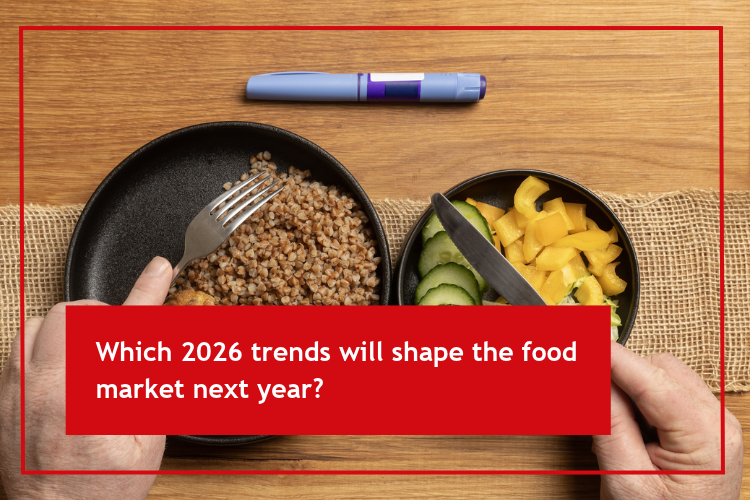
Ozempic, Wegovy, and other GLP-1 receptor agonists have brought a discussion that originally centered on health directly into food and beverage companies.
A Nestlé survey of 320 Brazilians aged 18 to 50, from socioeconomic classes A, B, and C and who pay some attention to diet and body care, found that 25% were using medications in this category. Another 18% said they had used them in the past. Among current users, 95% said they were seeking a healthier diet, while 59% were receiving nutritional guidance.
The commercial implications become clearer when looking at what happens in the shopping basket. In the United States, PwC research found that households with GLP-1 users spent 5.5% less on groceries. What they bought changed as well. Among current users, 61% said they were buying fewer sweets and 56% had cut back on salty snacks. In contrast, 44% were buying more fresh fruit and vegetables, 35% had increased purchases of packaged protein products, and 34% were buying more fresh protein.
Restaurants are also part of the equation. The study recorded an 8.7% reduction in spending at quick-service restaurants after six to eight months of medication use. Among current and former users, 35% said they would like smaller portions at proportionally lower prices, while 32% were interested in half portions or shared dishes without an additional charge.
These figures come from the United States and reflect the behavior of that market. Even so, the Brazilian research indicates that GLP-1 medications have already reached a significant share of the population surveyed and could influence purchasing decisions in Brazil as well.
For 2027, the commercial discussion involves both quantity and nutritional composition. If some consumers reduce the amount they eat, products featuring protein, fiber, and other nutritional attributes may compete for a larger share of daily consumption. Individual packs and smaller portions also deserve closer attention, particularly when they maintain a good balance between price and nutritional value.
The impact will vary considerably by category. Sweets, sugary drinks, and snacks face different challenges from yogurt, ready meals, or high-protein foods. Companies will need to assess the effects product by product and consumption occasion by consumption occasion, rather than simply concluding that consumers are becoming more health-conscious.
How much are consumers willing to pay in 2027?
NielsenIQ identified food inflation and household debt among the factors associated with declining purchase volumes in Brazil. Its Full View 2026 study showed that families are looking for ways to save, cutting expenses, shifting some out-of-home consumption toward e-commerce, and reprioritizing their budgets. Weight-loss medications and sports betting are now competing for a share of that same household spending.
Brand loyalty has also been affected by greater price sensitivity. Only 12% of consumers say they continue buying their usual brands regardless of price. A promotion, a smaller package, or a more affordable alternative may be enough to prompt a switch. One of the biggest challenges for the food sector is demonstrating product value to consumers who are constantly comparing their options.
Competing in this environment requires close attention to assortment, pack size, and promotions. A smaller package lowers the amount consumers pay at checkout, but the price per kilogram remains visible to anyone comparing value. Larger packs require a higher upfront spend and may work better for households that can concentrate more of their purchases into a single shopping trip.
Taste, price, and quality remain the leading priorities in food and beverage purchases, while healthier eating is the factor growing fastest in importance, according to recent McKinsey data. Consumers want more protein, high-quality ingredients, and convenience without stretching their budgets too far. In 2027, succeeding in the market will depend on delivering that combination at a price that makes sense in the shopping basket.
| Trend observed | What the 2026 data shows | Decision entering the 2027 planning agenda |
| GLP-1 and nutrition | 25% of the consumers surveyed by Nestlé use GLP-1 medications | Review portion sizes, nutritional composition, and consumption occasions |
| Pressure on household budgets | Only 12% would stick with their usual brands regardless of price, according to NIQ | Reassess assortment, pack sizes, pricing, and value proposition |
| Private label | The segment is growing by an average of 9.2% per year in Brazil | Assess private-label portfolios and manufacturing partnerships |
| AI | Only 2% of the companies surveyed by TraceGains have fully digitalized R&D processes | Integrate data before expanding AI applications |
| Digital foodservice | Apps account for an average of 58% of delivery sales among the establishments surveyed | Plan menus and operations for different channels |
From private labels to pack sizes, retailers rethink their choices
The search for more competitive prices is also reinforcing another major development on store shelves: the expansion of private labels. NielsenIQ data shows average annual growth of 9.2% in Brazil. Their household penetration is also notable, reaching 34% of families, with nearly 70% of consumers viewing the category as offering excellent value for money.
The appeal for retailers is clear. Developing an own-brand line gives them greater control over formulation, positioning, packaging, and price, while also creating exclusivity within their stores. It also influences negotiations with established brands, since price comparisons happen right there, side by side on the shelf.
In the food sector, this strategy ranges from everyday staples to healthier, convenient, and higher-value products. For companies manufacturing these items, private-label growth creates more opportunities to produce for third parties, bringing requirements around production capacity, standardization, food safety, and the flexibility to meet each client’s specifications.
Packaging also feeds directly into the retailer’s calculations. The search for a lower final price at checkout is intensifying discussions around portions and pack sizes, while the growing use of GLP-1 weight-loss medications adds another factor to decisions about ideal portion sizes. Practicality, ease of transportation, and waste reduction also influence format choices.
On the shelf, the decision comes down to the combination of brand, size, price, and consumption occasion within each category.
After experimenting with AI, it is time to put the technology to work
Artificial intelligence has been one of the hottest topics in the corporate world in recent years. In food and beverage, 2026 made the difference between simply testing a tool and actually integrating it into day-to-day operations increasingly clear.
A TraceGains survey of more than 400 professionals found that 40% identified disconnected systems and fragmented data as the biggest barriers to working more efficiently. A lack of confidence in data accuracy also continues to limit broader AI adoption.
The study highlighted another striking figure. Although 83% of the brands surveyed were increasing investment in new products, only 2% had fully digitalized Research and Development processes.
AI can already support research, formulation, market analysis, forecasting, documentation, and product development. The quality of the output, however, depends on the quality of the information entering the system. Technical specifications buried in spreadsheets, disconnected ingredient information, and inconsistent historical records significantly limit the potential for safe automation.
In food manufacturing, mistakes can be costly. Changing a recipe involves allergen controls, regulatory requirements, costs, raw-material inventory, and sensory profiles. Greater speed only delivers value when it is backed by full traceability and technical validation.
The focus, then, needs to be on results. AI should make a measurable difference to daily operations, whether by reducing the time spent reformulating a product, providing faster access to reliable ingredient data, or shortening the journey from product concept to shelf.
Those are the metrics that matter far more than simply counting how many platforms a company has purchased.
The same meal, more ways to buy it
How Brazilians choose where to buy food also deserves attention in 2027 planning. Abrasel projects that bars and restaurants will close 2026 with R$540 billion in revenue, nearly 9% above the R$495 billion recorded in 2025. In August, the sector posted 7.4% year-on-year growth, marking eleven consecutive months of expansion.
Revenue tells only part of the story. The number of ways businesses can reach customers has multiplied. A study commissioned by 99Food and conducted with Abrasel found that 86% of establishments offering delivery take orders through apps, which account for an average of 58% of their delivery sales. Behind the scenes, another figure deserves attention: 78% of establishments prepare dine-in and delivery orders on exactly the same production line.
That means a single kitchen has to handle very different consumption occasions, even when the operation was not originally designed for that dynamic.
Competition for the same meal also extends across different sales formats. Supermarkets are investing heavily in prepared foods and ready meals. Convenience stores capture demand for quick snacks, while restaurants divide their operations among dine-in, takeaway, and delivery. Consumers choose according to price, time of day, travel distance, and what is most convenient at that moment.
This mix of channels changes the strategy for companies selling food. A ready-to-eat product may compete both in a supermarket’s refrigerated section and on a delivery app at lunchtime. Similarly, a beverage may be purchased at a supermarket to stock the pantry, at a convenience store for immediate consumption, or as part of a delivery meal deal.
Brazilian food retail includes traditional supermarkets, cash-and-carry stores, neighborhood grocery stores, e-commerce, convenience stores, and fresh produce retailers in a vast commercial network. In out-of-home consumption, the continued growth of delivery is multiplying the number of touchpoints throughout the day.
The commercial challenge for 2027 is to determine where each product performs best. Packaging format, margins, portion size, and even formulation may need to be adjusted to work effectively in each channel.
What does 2026 already tell us about the food market in 2027?
The developments seen throughout 2026 point to consumers becoming more selective in how they choose, buy, and consume food. Price remains important, but purchasing decisions also take nutritional composition, convenience, portion size, and suitability for different consumption occasions into account.
For 2027, the details matter. A seemingly small change in the shopping basket may require adjustments to assortment, packaging, or formulation. A new eating habit can affect categories in very different ways. And the multiplication of sales channels means companies need to understand where, how, and in what format customers expect to find a particular product.
For businesses, 2027 begins with these decisions already on the table. Companies looking to put new products, formats, and propositions in front of buyers will have an important meeting point early in the year. From April 6 to 8, Anuga Select Brazil will bring the food and beverage market together at Distrito Anhembi in São Paulo. In 2026, the event welcomed more than 14,000 visitors, brought together participants from 74 countries and more than 550 brands, and hosted 2,500 meetings through its invited buyers program.
If your company wants to be part of what consumers will find on shelves, menus, and across different points of sale and consumption in the year ahead, now is the time to secure your space. Exhibit at Anuga Select Brazil 2027, present your products directly to the market, and meet buyers looking for what is next in the sector.
Click here to learn how to exhibit.
Perguntas frequentes
What trends are expected to shape the food market in 2027?
Key developments include the effects of GLP-1 medications on eating habits, greater price sensitivity, private-label growth, practical applications of artificial intelligence, and the multiplication of sales channels across retail and foodservice.
How could GLP-1 medications affect the food market?
Smaller portion sizes and greater demand for protein, fiber, and foods with stronger nutritional profiles may influence product categories, packaging formats, formulations, and consumption occasions.
Why are private labels expected to remain important in 2027?
Private labels already reach 34% of Brazilian households and appeal to consumers who are paying close attention to the relationship between price and quality. For retailers, they also provide greater control over product assortment, positioning, packaging, and price points.
How can food companies prepare for 2027?
Planning should take into account changes in purchasing behavior, price sensitivity, nutritional preferences, and differences between sales channels. Assortment, portion sizes, packaging, formulations, and the use of data are among the areas companies should assess for the year ahead.