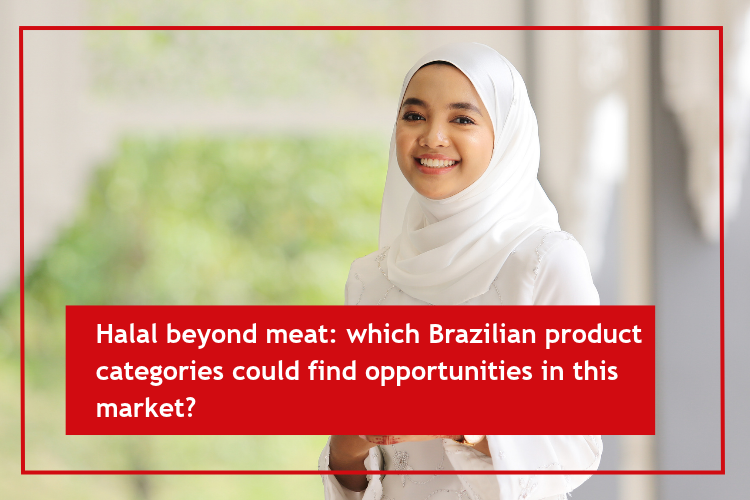
The Halal market covers non-alcoholic beverages, ingredients and additives, confectionery, dairy products, processed foods and nutrition products. Muslim consumers spent US$1.53 trillion on food and beverages in 2024, with spending projected to reach US$2.06 trillion by 2029. Brazil has extensive experience trading with these markets and has room to diversify its presence with processed and higher-value products. At Anuga Select Brazil, this potential is also reflected in the Halal Zone, a dedicated space for products, services and business opportunities in the segment.
Contents
- Brazil already holds a strategic position in the Halal market
- The Halal market extends across a wide range of food categories
- Which Brazilian products could serve the Halal market?
- Certification requires close attention to ingredients and destination markets
- Halal Zone connects certified products with new business opportunities
- Frequently asked questions
Brazil already holds a strategic position in the Halal market
The Halal market accounts for a significant share of global food consumption, yet in Brazil it is still commonly associated with beef and poultry. The commercial possibilities are much broader. Non-alcoholic beverages, ingredients, confectionery, dairy products, processed foods and nutrition products are among the categories that can serve Muslim consumers as well as companies seeking certified raw materials.
The scale of this consumer market is also relevant to other areas of Brazilian food production. According to the State of the Global Islamic Economy Report 2025/26, published by DinarStandard, Muslim consumers spent US$1.53 trillion on food and beverages in 2024. That figure is projected to reach US$2.06 trillion by 2029.
Brazil already has a strong position in this trade relationship. In 2024, it was the largest food exporter to countries of the Organisation of Islamic Cooperation (OIC), with exports totaling US$32.96 billion, according to data from the same report published by Salaam Gateway. The country also ranked fifth globally for its Halal food ecosystem.
Much of this presence has been built on animal proteins. The experience Brazil has accumulated in certification, exports and trade relations with Muslim-majority countries now raises another challenge: increasing the share of processed and higher-value products in its export portfolio.
The Halal market extends across a wide range of food categories
Halal is the term used for what is considered lawful or permissible under Islamic principles. In food production, the concept covers product composition, the origin of raw materials and the procedures followed throughout the production process until the product reaches the consumer.
This broad scope can be seen in the categories covered by FAMBRAS Halal Certificadora. The organization certifies finished products, raw materials, inputs and food additives. These include ingredients, milk and dairy products, pasta, flour, sugar, salt, non-alcoholic beverages, water, ready-to-eat products, processed fruits and vegetables, eggs, fish and canned foods.
The breadth of this list matters for Brazilian businesses that have never worked with animal protein as their core activity. A flavoring company, dairy producer, confectionery manufacturer or beverage brand may already have products suited to this audience, provided it can meet the required standards and demonstrate compliance across its ingredients and production processes.
Certification also applies to business-to-business supply chains and can cover inputs used to manufacture other products. FAMBRAS itself highlights Brazil’s role in supplying Halal ingredients and additives to both domestic and international customers.
Which Brazilian products could serve the Halal market?
Non-alcoholic beverages are one of the broadest categories with potential in this market. Juices, coffee, tea, coconut water, fruit-based beverages and functional drinks are some examples. For alcohol-free beverages, the assessment also covers ingredients used in the formulation, including flavorings, colorings and stabilizers.
Ingredients and additives are also particularly relevant to B2B operations. Sugar, flour, starches, oils, flavorings, colorings, emulsifiers, stabilizers and thickeners can be supplied to customers that need to maintain compliance in their own formulations. In these cases, tracing the origin of each input and documenting its components are part of the process.
In confectionery, potential products include chocolates, candies, biscuits, fillings, coatings and desserts. Some formulations require closer attention to the origin of gelatin, fats, emulsifiers, colorings and flavorings.
Dairy is another category covered by FAMBRAS certification. Powdered milk, cheeses, yogurts, dairy beverages, desserts and milk-derived ingredients can serve buyers working with Halal products. Depending on the formulation, cultures, enzymes, rennet and flavorings may also need to have a known origin and comply with the applicable requirements.
Processed foods bring the discussion into higher-value product categories. Pasta, sauces, preserves, ready meals, snacks, frozen foods and processed fruits and vegetables are among the possibilities. In an article published by the Brazil-Arab News Agency in September 2026, FAMBRAS Halal Certificadora president Mohamed Zoghbi identified processed food products as one of the areas where Brazil still has room to expand.
There is potential in supplements and nutrition products as well. Protein powders, vitamins, nutraceuticals and other formulations may contain capsules, gelatin, excipients and raw materials whose origins need to be verified. FAMBRAS lists nutraceuticals and vitamins among the categories eligible for certification.
Other areas of the Halal economy also represent substantial consumer spending. According to DinarStandard, spending on Halal pharmaceuticals reached US$112 billion in 2024 and is projected to rise to US$146 billion by 2029. Cosmetics accounted for US$92 billion, with spending expected to reach US$124 billion over the same period.
Brazil and some of the leading food markets in the Islamic economy
|
Market |
2024 figure |
What the figure indicates |
|
Brazil |
US$32.96 billion in food exports to OIC countries |
The largest external food supplier to these markets |
|
Saudi Arabia |
US$29.63 billion in food imports |
The largest food importer among OIC countries |
|
United Arab Emirates |
US$22.71 billion in imports |
One of the region’s leading destinations and commercial hubs |
|
Türkiye |
US$20.06 billion in imports |
Also a major consumer market, with US$120.1 billion in food and beverage spending |
|
Egypt |
US$18.99 billion in imports |
The fourth-largest Muslim food consumer market, with US$119.8 billion in spending |
The figures cover food trade with OIC countries and are not limited to Halal-certified products. Source: State of the Global Islamic Economy Report 2025/26, DinarStandard/Salaam Gateway.
Brazil already exports large volumes of food to these countries and is familiar with some of the trade channels involved. This established commercial presence may support the entry of other Brazilian categories, such as beverages, confectionery and ingredients, into negotiations with buyers across the region.
Certification requires close attention to ingredients and destination markets
Once a category with commercial potential has been identified, the next step is to assess the product in detail, starting with its composition.
Gelatin, enzymes, emulsifiers, fats, flavorings and other components can come from different sources. Traceability is necessary because the compliance of the finished product also depends on the raw materials used. FAMBRAS emphasizes this oversight throughout the production process when outlining the criteria applied to foods, inputs and additives.
Manufacturing facilities and production procedures are also part of the assessment. Equipment, storage, handling and contact with substances considered Haram, or prohibited, need to be evaluated according to the activity and product involved. Packaging may also be subject to these controls. The Brazilian certifier has a specific certification category for packaging intended for Halal products, taking into account the risk of contact with incompatible materials.
Another commercial consideration is choosing the destination country before structuring an export strategy. Certification rules, recognized certification bodies and documentation requirements can vary. A product developed for a buyer in Saudi Arabia, for example, may face different procedures from those required in other countries.
Defining the destination in advance helps determine which requirements need to be addressed and avoids treating the Halal universe as a single regulatory market. It can also guide decisions on formulation, documentation and commercial partners before a company invests in international expansion.
This preparation becomes increasingly relevant as individual countries develop their own regulatory systems. Indonesia, for example, introduced mandatory certification in October 2024 for certain food and beverage products made by medium and large companies, including raw materials, additives and processing aids.
Halal Zone connects certified products with new business opportunities
Having a product that can meet Halal requirements is one part of a commercial strategy. The next step is putting it in front of importers, distributors and professionals who understand the specific characteristics of these destinations and are looking for new business partners.
The Halal Zone at Anuga Select Brazil provides a dedicated meeting point within the trade show. Organized in partnership with FAMBRAS Halal Certificadora, the pavilion is dedicated to Halal food, beverages, products and services, combining exhibition opportunities with specialized content and business connections.
Since its first edition, the space has also introduced visitors to topics related to Halal principles and the certification process. The presence of specialists creates opportunities to discuss requirements, adaptations and questions that may arise as companies prepare to serve different countries.
In 2027, the Halal Zone returns to the official Anuga Select Brazil show floor alongside the Arab-Brazilian Chamber of Commerce and other areas dedicated to international relations in the food and beverage sector. Buyers and companies can use the space to discuss products, destination markets and potential partnerships directly.
Would you like to present your company to professionals interested in Halal products?
Find out how to take part in the next edition here.
Perguntas frequentes
Which products can receive Halal certification?
Certification can cover meat, non-alcoholic beverages, ingredients, additives, confectionery, dairy products, processed foods, ready-to-eat products, supplements and other categories. The assessment considers product composition, the origin of raw materials and the production process.
Does a meat-free product need Halal certification?
enzymes, flavorings and fats may come from sources that are incompatible with Islamic principles, which means both the formulation and its inputs need to be assessed.
Is Brazilian Halal certification accepted in every country?
Acceptance depends on the rules of the destination market and whether the certifying body is recognized by local authorities. Before exporting, companies should define their priority markets and check the requirements that apply to each product.
How can a Brazilian company start operating in the Halal market?
The first step is to identify which products have commercial potential and which destination markets are relevant to the company. From there, the business can review certification requirements, assess raw materials and production processes, and establish contact with buyers, distributors and industry specialists.