Quick summary: Artificial intelligence is finding practical applications across the food and beverage sector, from recipe development to inventory management, quality control and customer service. Keeping up with these changes means paying attention to the places where the industry comes together to discuss innovation, and Anuga Select Brazil is emerging as one of the key meeting points for these conversations.
Contents
- A new way of thinking about the industry
- AI in the food and beverage industry is accelerating product development
- On the factory floor, anticipating problems reduces losses and improves control
- In retail and foodservice, inventory and product offerings become more precise
- Faster customer service at the final touchpoint
- Results depend on where AI is applied
- Frequently asked questions
A new way of thinking about the industry
Artificial intelligence is already part of day-to-day operations for companies across the sector, with applications extending into different areas of the business. The impact of AI in the food and beverage industry can be seen from strategic planning to the factory floor, influencing costs, waste, speed to market and sales volumes through increasingly detailed analysis.
To put the scale of this market into perspective, data from the Brazilian Food Industry Association (ABIA) shows that the sector generated BRL 1.388 trillion in revenue in 2025, alongside BRL 41.3 billion in investments. In an industry of this size, technology is playing an increasingly important role by connecting data on sales, inventory, weather, equipment performance and purchasing behavior to identify patterns that can be difficult to detect through manual analysis.
Much of this activity also happens behind the scenes, often without consumers even noticing. AI can help guide ingredient selection, plan supply levels for individual points of sale and improve customer service across digital platforms.
AI in the food and beverage industry is accelerating product development
Developing a food product requires a careful balance between flavor, texture, cost and consumer acceptance. Changing the amount of sugar, for example, can affect consistency, while replacing an ingredient to reduce costs may alter the aroma.
Consumer preferences, including growing demand for zero-sugar and high-protein products, are also pushing companies to develop new formulations. This interest is reflected in investment levels: a TraceGains survey found that 83% of brands in the sector planned to increase their R&D spending in 2025, with 17% already making extensive use of AI in the food and beverage industry for product development and another 45% testing the technology.
Consider the development of a plant-based alternative to an animal-derived product. Finding the right combination of proteins, fats and fibers to achieve the desired aroma and texture can require numerous formulations and rounds of testing. Today, algorithms can analyze molecular and sensory characteristics before a recipe even reaches the test kitchen, helping teams explore promising new flavors and combinations more efficiently.
Human validation remains a crucial part of the process. Products still need to be tasted and assessed for stability, texture, aroma and sensory acceptance. The difference is that teams can focus their efforts on the most promising options, saving both time and ingredients.
This becomes even more useful when the price of an ingredient rises or a recipe needs to contain less sodium without losing its appeal. Evaluating potential substitutions before moving into kitchen trials can shorten the development process and avoid unnecessary testing.
On the factory floor, anticipating problems reduces losses and improves control
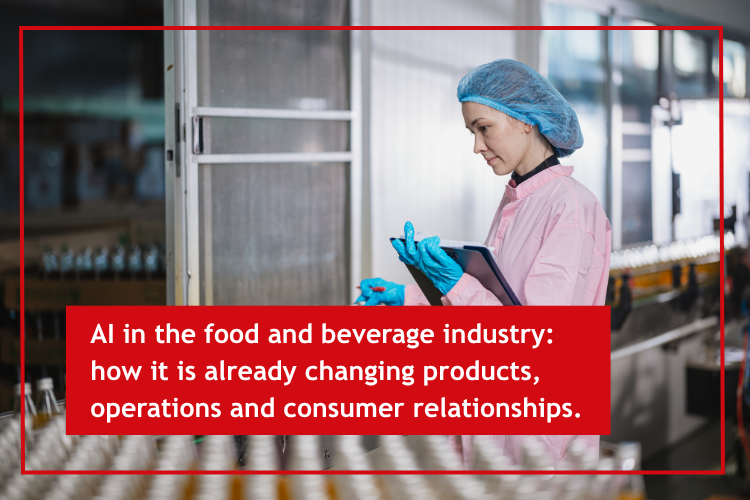
In production, AI can help anticipate problems and reduce the risk of losses. Sensors installed across machinery monitor temperature, vibration and speed, allowing maintenance to be scheduled before a component fails and brings an entire production line to a halt.
Quality control can also be automated using computer vision. Cameras positioned along production lines check characteristics such as color, size, shape and degree of cooking in real time, identifying deviations as soon as they occur.
Demand forecasting offers another application. Historical sales data can be combined with weather, seasonality, holidays, promotions and consumer trends. A period of unusually hot weather, for example, may increase demand for beverages and ice cream, while holidays and special occasions can change the performance of specific product categories. Factoring in these variations helps bring production volumes closer to what consumers actually buy.
This fine-tuning can also help reduce waste. Producing too little can leave shelves empty, while producing too much can result in losses from expired products. Better forecasts help balance inventory levels and make logistics easier to manage.
The table below shows a few examples of how AI can be applied, the information involved and the potential impact on operations.
| Where AI is applied | Information analyzed | Potential impact |
| Product development | Ingredients, composition and sensory testing | More targeted formulations |
| Predictive maintenance | Equipment performance and behavior | Fewer unexpected shutdowns |
| Quality control | Images and production standards | Faster identification of deviations |
| Demand forecasting | Sales, weather, seasonality and calendar data | Better-aligned production and inventory |
| Perishable goods management | Sales turnover, inventory and expiration dates | Lower risk of losses |
| Personalization | Purchase history and shopping habits | More relevant offers |
In retail and foodservice, inventory and product offerings become more precise
The food-away-from-home sector is also beginning to incorporate these solutions. The National Restaurant Association’s State of the Restaurant Industry 2025 report found that 28% of operators planned to invest in the technology to address longstanding challenges in areas such as inventory purchasing, marketing and kitchen workflows.
Supermarket chains, e-commerce businesses and restaurants collect large amounts of information about consumer habits. Analyzing this data can help recommend products based on previous purchases while taking individual preferences and dietary restrictions into account automatically.
For produce, deli products and dairy, shelf life becomes particularly important. Systems can compare the sales rate at each store with the remaining shelf life of a product and alert managers when it may be time to offer a discount to sell a batch before it spoils.
This type of pricing can reduce losses on perishable goods and help products sell before they lose their commercial value. In restaurants and quick-service establishments, meanwhile, mapping peak hours, best-selling dishes and frequently unused ingredients can support purchasing and menu decisions, bringing kitchen operations closer to actual customer demand.
Faster customer service at the final touchpoint
Consumer acceptance of automation depends largely on how well technology and human interaction are balanced. A global YouGov study conducted with Zendesk in 2025 found that 54% of consumers see virtual assistants as a way to make customer service faster, while 84% still consider access to a human agent important when needed.
This is where AI in the food and beverage industry can play a more direct role in the customer experience. Generative AI assistants can move beyond the rigid menus of traditional chatbots, understanding questions in natural language and working with product and delivery information to provide direct answers.
For food and beverage brands, this can mean answering questions about allergens, suggesting recipes based on ingredients a consumer already has at home or providing details about where a particular ingredient comes from.
The experience can become more relevant when a customer’s purchase history is also taken into account. Someone who regularly buys gluten-free products, for example, can receive recommendations that better match their profile instead of irrelevant offers. Routine questions can be handled through automation, while more complex cases are directed to a human team.
Results depend on where AI is applied
The first step in adopting these tools is identifying the operation’s main challenge, whether that is equipment failure, losses caused by expired products, inaccurate purchasing forecasts or customer service bottlenecks. Once the problem is clear, it becomes easier to determine which data the system needs.
The quality of that input makes a significant difference, and human oversight remains essential to ensure food safety, regulatory compliance and strong customer relationships.
For those looking to understand how AI in the food and beverage industry is being applied in real-world settings, Anuga Select Brazil is establishing itself as an ideal environment to see some of the latest developments in the market. The event brings together manufacturers, suppliers, distributors and retailers interested in exchanging experiences and discovering practical new solutions for the sector.
Taking part in an event of this scale can turn industry discussions into partnerships and new business opportunities. For companies developing technology and automation solutions, the trade show provides a valuable platform to present innovations directly to the professionals making investment decisions across the sector.
Interested in exhibiting at the next edition? Showcase your brand and solutions at Anuga Select Brazil 2027, taking place from April 6 to 8 at Distrito Anhembi in São Paulo. Click here to learn how to participate.
Perguntas frequentes
How is artificial intelligence used in the food and beverage industry?
Artificial intelligence is used in product development and reformulation, predictive maintenance, quality control, demand forecasting, inventory management, offer personalization and customer service.
How does AI support the development of new food products?
AI can analyze ingredients, composition, sensory characteristics and different formulation combinations. This helps teams focus testing on more promising alternatives, including plant-based products and recipes designed with lower sugar or sodium content.
How can artificial intelligence help reduce food waste?
By combining historical sales data with seasonality, weather, events, inventory levels and expiration dates, AI can improve demand forecasting and help companies better align production and supply. In retail, it can also identify products at greater risk of going unsold and support promotional decisions before they expire.
What role does AI play in consumer relationships?
AI can personalize recommendations and offers based on purchasing habits and preferences while also making digital customer service more efficient. Generative AI chatbots can answer questions about products and deliveries, suggest recipes and provide information about ingredients and their origins.